The Inclusion-Belonging Continuum
So often inclusion is seen as black and white. You are inclusive, bringing people in, or you are exclusive keeping people out. At surface level this framing of them as opposites makes sense. But in reality, there is a lot we don’t see in between.
In many workplaces, schools, and social groups, the greatest barrier to inclusion is not active exclusion at all, it’s indifference. The majority of people are not deliberately trying to make others feel unwelcome and most organisations are not openly designed to exclude anyone. However, too many people are still experiencing feeling unseen, unheard or disconnected.
When Inclusion Stops at Access
Modern organisations have become increasingly aware of the importance of inclusion with teams speaking openly about diversity. Institutions create policies intended to widen participation and leaders emphasise openness and collaboration.
And yet many people still experience environments where they are technically included but do not feel they truly belong. They are invited to the meeting, but their ideas carry less weight. They are part of the team, but important decisions happen in informal conversations they are not part of. Or they are present in the classroom, but do not see themselves reflected in the curriculum or culture.
This is the subtle difference between access and belonging.
Access says: “You are allowed to be here.” But belonging says: “You matter here.”
And it is the gap between those two experiences where many inclusion efforts fail.
The Problem with Passive Inclusion
One of the challenges with inclusion is that organisations often approach it passively. They assume that once barriers are removed, inclusion will naturally follow, but meaningful inclusion rarely happens by accident.
Every workplace, school, and social environment has invisible norms in how people communicate, and then who gets heard. What behaviours are rewarded and whose perspectives are considered “normal”, and this then determines where influence actually exists. These norms are often unintentional, but they shape participation powerfully.
For example:
- Meetings may favour the loudest voices rather than the most thoughtful ideas.
- Networking opportunities may happen in informal social settings that not everyone can access comfortably.
- Schools may reward one style of learning while overlooking others.
- Social groups may rely heavily on shared history and inside language that quietly isolates newcomers.
In these situations, exclusion is not always active hostility, it is more often a failure to notice.
A failure to ask:
Who is not participating?
Who is adapting themselves to fit in?
Who is present but disconnected?
Inclusion Requires Design
Good inclusion is intentional design and requires leaders, educators, and communities to actively shape environments where different people can contribute meaningfully without having to erase parts of themselves. We’re tired of wearing the mask.
That might mean:
- structuring meetings so quieter voices are heard
- making decision-making more transparent
- creating multiple ways for students to learn and participate
- ensuring newcomers are integrated rather than simply invited
- rewarding collaboration and empathy alongside confidence and visibility
The Difference Between Diversity and Belonging
Where it can get confusing is when considering the difference between diversity and inclusion or belonging. Diversity can be a measurable metric, belonging is experiential and it is much more difficult to capture.
You can measure representation in a room but you can’t easily measure whether people feel psychologically safe enough to contribute honestly once they are there. And this is why inclusion cannot stop at numbers or visibility.
A genuinely inclusive environment changes not only who enters the room, but whose perspectives influence what happens inside it.
In fact, the healthiest environments are often those where people feel least pressure to perform sameness.
A Better Question
Perhaps the most useful question is not:
“Who are we excluding?”
But:
“Who have we failed to consider?”
That shift changes inclusion from a moral slogan into an operational practice. Because the opposite of inclusion is not always exclusion. Sometimes it is invisibility. Sometimes it is neglect. Sometimes it is the quiet assumption that if no one is openly rejecting people, then everyone must already feel welcome. But people can be surrounded by opportunity and still feel unseen. Real inclusion begins when we notice that difference and choose to design for belonging, not just access.
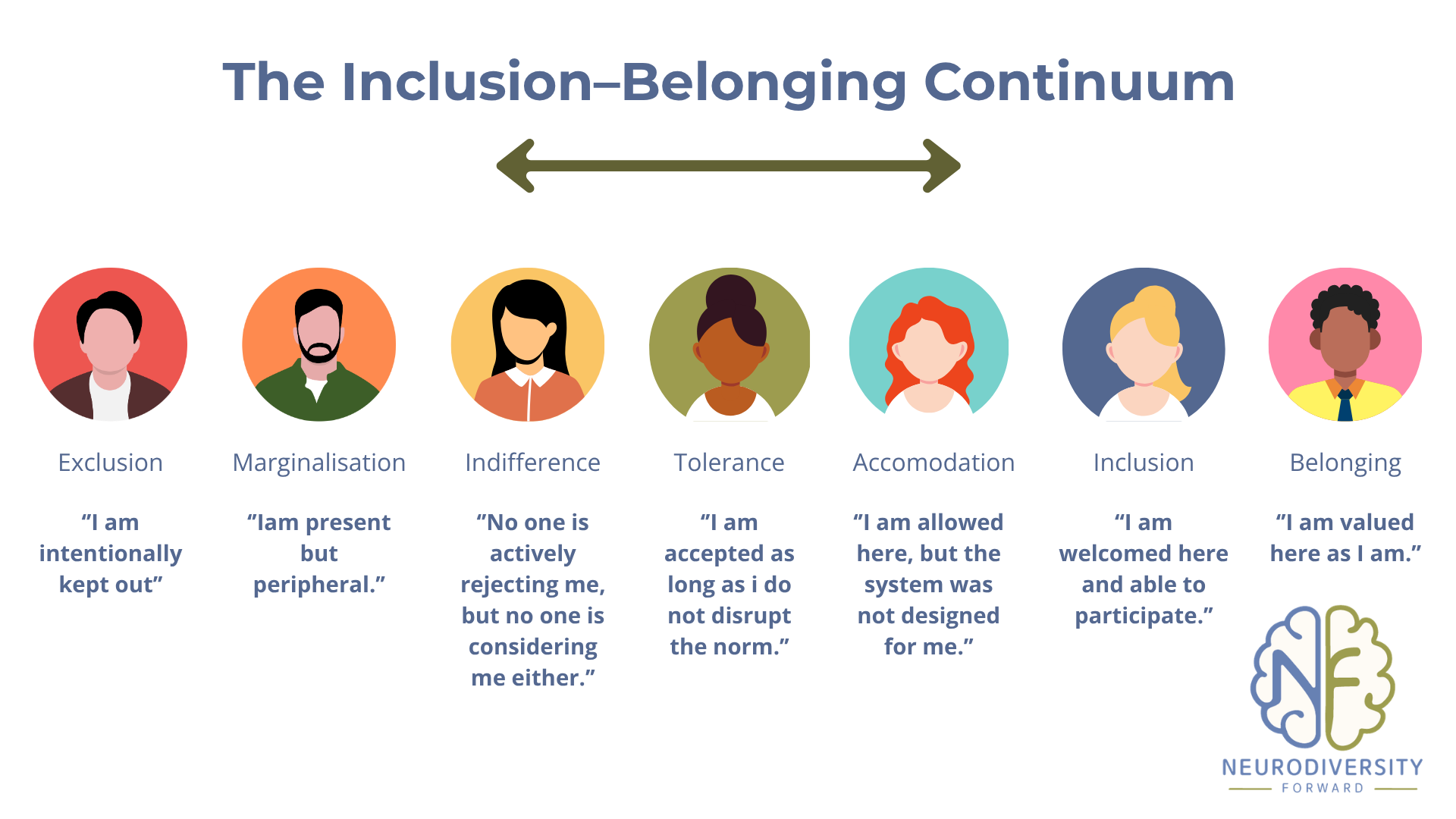
The Inclusion-Belonging Continuum
A better way to think about inclusion is not as a binary opposite of exclusion, but as a spectrum ranging from belonging to marginalisation.
These observations have helped me develop the ‘Inclusion-Belonging Continuum’. A practical continuum synthesised from existing work in organisational inclusion, belonging theory, and participation frameworks which fills in the gaps between inclusion and exclusion.
At the top of the scale…
1. Belonging
“I am valued here as I am.”
At this level:
- people feel psychologically safe
- their perspectives influence outcomes
- difference is seen as an asset, not a disruption
- individuals do not feel pressure to hide parts of themselves
This is deeper than inclusion as it has active recognition and meaningful participation. Belonging is not a “soft” pastoral concept, it is a psychological condition that directly influences a person’s motivation, cognitive engagement and persistence under challenge.
2. Inclusion
“I am welcomed and able to participate.”
At this level:
- access exists
- participation is encouraged
- systems are intentionally designed to involve different people
- individuals have opportunities to contribute
Inclusion creates entry and participation, but may not yet create deep emotional connection or influence.
3. Accommodation
“I am allowed here, but the system was not designed for me.”
At this level:
- adjustments are made reactively rather than proactively
- individuals often carry the burden of adaptation
- participation is possible, but can feel effortful or conditional
Examples:
- accessibility added as an afterthought
- flexible working granted as an exception rather than normal practice
- people feeling grateful simply to be “allowed in”
Accommodation is often mistaken for inclusion, but it still assumes a dominant norm that others must work around.
4. Tolerance
“I am accepted as long as I do not disrupt the norm.”
At this level:
- difference is permitted, but not embraced
- conformity is quietly rewarded
- people self-monitor to fit cultural expectations
Common signs:
- “professionalism” defined narrowly
- pressure to minimise accents, cultural differences, or unconventional viewpoints
- diverse people present, but dominant behaviours unchanged
Tolerance may appear peaceful on the surface, but often produces emotional exhaustion and disengagement.
5. Indifference
“No one is actively rejecting me, but no one is considering me either.”
This is often the hidden centre of the scale.
At this level:
- exclusion is passive rather than intentional
- systems default to the majority experience
- overlooked groups become invisible rather than explicitly rejected
Examples:
- meetings scheduled without considering caregiving responsibilities
- educational materials reflecting only one cultural perspective
- social networks forming around familiarity and habit
Indifference is powerful because it often feels normal to those who benefit from the default system.
6. Marginalisation
“I am present, but peripheral.”
At this level:
- people are technically included but lack influence
- voices are ignored, interrupted, or undervalued
- participation becomes symbolic rather than meaningful
This is where tokenism often exists.
People may be visible without being empowered.
7. Exclusion
“I am intentionally kept out.”
At this level:
- barriers are explicit or enforced
- access is restricted
- participation is denied
Examples:
- discrimination
- gatekeeping
- bullying or social isolation
- policies or practices that deliberately restrict access
Exclusion is the clearest and most visible end of the spectrum, but not the most common. Often we consider that if we are not here we must be inclusive.
A Key Insight
Most organisations believe they operate somewhere between inclusion and belonging. In reality, many operate between tolerance and indifference because people do not disengage only when they are excluded.
They also disengage when they feel unseen, unheard, replaceable or required to adapt constantly to environments never designed with them in mind.
True inclusion is not simply the absence of exclusion. It is the active creation of belonging.
If you have found this model helpful or interesting in some way please share my blog post and comment below.