Capacity isn’t capability: understanding neurodiversity at work
Why someone can be capable of doing something but struggle to access that capability consistently
“But they did it last week.” I hear you say. It’s a comment that can be easy to understand from a manager’s perspective. Someone has produced an excellent piece of work before, managed a busy project successfully or demonstrated that they have the skills to do something. Then, a few weeks later, they are struggling to get started, missing deadlines or becoming overwhelmed by a workload they have previously managed.
From the outside, that can look like inconsistency. For the person experiencing it, there is likely be a lot more going on, and very often we can remove or reduce the impact of these things.
One concept I think is particularly useful when talking about neurodiversity at work is the difference between capability and capacity.
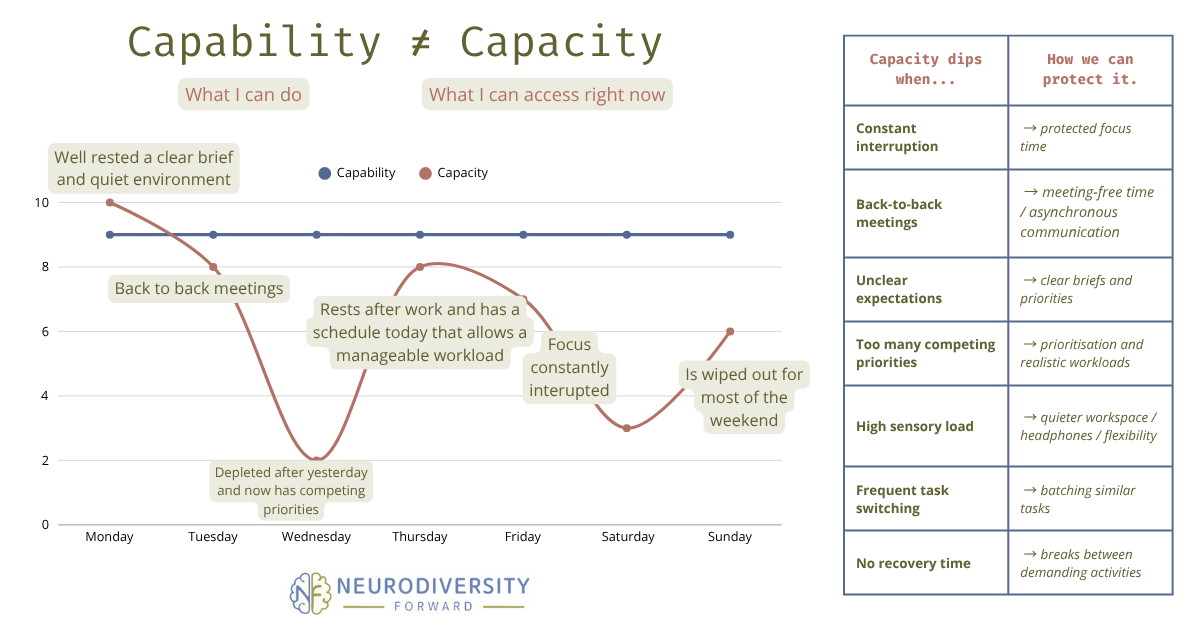
Capability is the knowledge, skills and ability someone has. Capacity is what they can access at a particular point in time, within the conditions and environment they are working in.
Everyone’s capacity changes throughout the day and across the week. Sleep, stress, illness, competing demands, emotional load and what is happening around us can all affect how much energy and attention we have available.
For some neurodivergent people, factors such as sensory processing, executive functioning, attention regulation, task switching and emotional regulation can have a significant impact on that available capacity.
BUT…The underlying capability can remain the same.
What does this look like at work?
Imagine someone who is highly capable of producing detailed, thoughtful work.
On Monday morning, they have a clear brief, a manageable workload and two hours protected from meetings and interruptions. They get into the task and produce something they are proud of.
By Wednesday, their diary is packed with meetings. Priorities have changed twice. They have several messages waiting for a response and a new piece of work has landed without a particularly clear deadline. The office is busy and noisy, and they have barely had time to stop between meetings.
The task itself hasn't become more difficult and the person hasn't suddenly lost the skills they demonstrated on Monday. However, a much greater proportion of their cognitive capacity is now being used to manage everything around the task.
They have to work out which priority comes first. They have to hold information from several meetings in mind. They are switching between emails, conversations and pieces of work. They are filtering out background noise. They are trying to remember what they were doing before the last interruption.
Eventually, they sit down to do the report…And they just can't seem to start.
This is where executive functioning and ADHD at work can become particularly relevant. Planning, prioritising, initiating tasks, managing time, switching attention and holding information in mind all require cognitive effort. When the surrounding environment is already demanding a lot of that effort, less may be available for the task itself.
From a manager's perspective, the difference between Monday and Wednesday might look like a difference in motivation or performance.
For the employee, it may feel like: “I know what and how to do this. I just can't seem to get myself to do it.” That experience can be incredibly frustrating, particularly when the person knows they have done the same thing successfully before.
What is using up the available capacity?
This is where you as a manager or leader can make the difference.
When someone is struggling, we often go straight to the individual. We talk about time management, organisation, resilience, prioritisation or strategies for managing their workload. Those things can be useful. Coaching and individual strategies can make a real difference but there is also value in looking at the environment around the person.
A workplace can place additional demands on attention and executive functioning without anyone deliberately intending to create a barrier.
- Constant interruptions require repeated attention switching.
- Back-to-back meetings reduce opportunities to process information and complete focused work.
- Unclear priorities mean that deciding what to do becomes another task.
- Frequent changes can require additional processing and planning.
- A busy sensory environment can consume attention that someone would otherwise have available for their work.
- Multiple competing deadlines can make prioritisation considerably harder.
None of these things will affect every neurodivergent person in the same way. They can affect non-neurodivergent employees too. The important point is that the working environment forms part of the picture when we are looking at someone's capacity to perform.
What could change?
This is where relatively small and simple changes can have a very meaningful impact.
- A manager might protect periods of uninterrupted focus rather than filling every available space in the diary.
- A team might agree which communication needs an immediate response and which can wait.
- A project lead might make the priority and deadline explicit rather than presenting several tasks as equally urgent.
- Meetings might include time to process information rather than moving immediately from one demanding conversation to the next. You will very often get better input from everyone if you do this.
- Instructions might be provided in writing alongside a verbal conversation.
- Someone working in a highly stimulating environment might have access to a quieter space or greater flexibility over where they complete certain tasks.
These are examples of reasonable adjustments where they are appropriate for an individual's needs, but they can also form part of good workplace design more generally as part of good universal design.
Acas guidance on reasonable adjustments for neurodivergent workers includes measures such as quiet spaces, regular breaks, clearer instructions, breaking work into smaller tasks, additional planning time and advance warning of changes. It also emphasises the importance of considering the individual's particular needs rather than assuming that everyone with the same neurodivergence will require the same support.
That individual element matters which is why there isn't a standard set of “ADHD adjustments” or “autism adjustments” that will work for everyone. Two people with the same diagnosis can have very different strengths, challenges, preferences and working environments.
A useful conversation starts with the individual.
What is getting in the way? What helps? What could make accessing the work easier?
Reasonable adjustments and the question of expectations
There can be a perception that workplace adjustments involve making someone's job easier or lowering the expected standard.
In practice, an adjustment can simply change the conditions in which someone is working.
If an employee can produce high-quality work but finds sustained concentration difficult in a noisy environment, access to a quieter space doesn't change the quality expected from their work.
If someone processes written information more effectively than lengthy verbal instructions, providing information in writing doesn't remove the responsibility to understand and act on it.
If several tasks have competing deadlines, clarifying the order of priority doesn't complete the work for the employee.
The standard can remain the same while the barrier is reduced.
Acas describes reasonable adjustments as changes that can remove or reduce a disadvantage experienced by a disabled worker. Its guidance also encourages employers to consider the strengths neurodivergent employees bring to the workplace.
That distinction is important because good support gives people a fair opportunity to demonstrate their capability.
When fluctuating capacity gets mistaken for poor performance
This is why the distinction between capacity and capability can become particularly important for managers. If someone's performance changes significantly from one period to another, it can be tempting to focus on the inconsistency itself.
Why did they manage it last month but struggling now?
Why can they concentrate on one task for three hours but struggle to start another?
Why can they manage a huge deadline when it is urgent but not get started when they have three weeks to complete it?
Those questions can lead to assumptions about motivation, attitude or effort.
A better understanding of executive functioning, neurodivergence and workplace wellbeing can provide another perspective.
Performance happens within a context.
The workload, environment, communication, expectations, relationships, sensory demands and amount of recovery time available can all influence what someone is able to access on a particular day.
This doesn't mean that every performance difficulty is caused by the workplace, or that expectations should disappear. It means that understanding the circumstances can help managers respond proportionately and identify support that may make a difference.
What happens when people keep working beyond their capacity?
There is another reason this really matters.
Many neurodivergent employees become very good at compensating. This might look like working later, checking everything repeatedly, using enormous amounts of energy to appear organised and masking difficulties. They may also push through sensory overload and rely on urgency and adrenaline to get things finished.
From the outside, this can look like someone who is coping perfectly well but the true cost may only become visible when that level of effort can no longer be sustained.
This is one reason neurodivergent burnout and workplace wellbeing deserve more attention. A person can be performing well while using far more resources to achieve that performance than the organisation can see.
Building workplaces that protect capacity
Neuroinclusion doesn't mean creating a workplace where everyone works in exactly the way that suits them best all of the time.
It means becoming more thoughtful about the barriers that are built into the way work is organised.
- Clear communication.
- Realistic workloads.
- Good meeting practices.
- Predictability.
- Flexibility.
- Managers who understand neurodiversity.
All of these can help create an environment where people can talk openly about what helps them work effectively and can make it much easier to identify useful support before difficulties escalate.
This benefits far more than neurodivergent employees. Most people have experienced periods when their capacity has been reduced by stress, poor sleep, caring responsibilities, illness, a heavy workload or a particularly demanding period of life.
Designing work with human capacity in mind is therefore a wider workplace wellbeing issue, as well as an important part of neuroinclusive practice.
Capacity can change. Capability can remain.
Going back to that original comment:
“But they did it last week.”
They may well have and their ability hasn't necessarily changed but the conditions around them may have. Understanding that distinction gives managers, HR teams and organisations another way to think about neurodiversity in the workplace.
Capability tells us what someone can do.
Capacity tells us what they can access at a particular point in time.
And sometimes, changing the environment can make a bigger difference than asking the individual to change themselves.